




02 June 2026 – Voice of the Future 2026

Voice of the Future 2026 was a parliamentary engagement event held on 19 March 2026 at Portcullis House, Houses of Parliament. It brought together early-career scientists and representatives from STEM societies and professional scientific bodies to put questions directly to parliamentarians and MPs. The Genetics Society was among 15 organisations invited to send representatives.
Voice of the Future is organised by the Royal Society of Biology in partnership with a broad coalition of scientific societies, and the Genetics Society is one of them. The event aimed to represent the full breadth of the UK’s scientific community in dialogue with Parliament.
The participating member, Esra Sengul, acted as the questioner and was accompanied by backup Karina Piotrowska. Each organisation’s representatives prepared and posed questions to the parliamentarians and speakers across the three sessions. Later, an informal networking session allowed participating members to connect directly with members of Parliament, discussing key issues in academia in a low-stakes, relaxed atmosphere.
The event centred on several recurring themes: the relationship between science and government policy; STEM education, diversity and careers (particularly for women and underrepresented groups); public trust in science and combating misinformation; healthcare science workforce and NHS capacity; research funding stability and early-career researcher precarity; numeracy and mathematics teaching; and nature/biodiversity alongside climate.
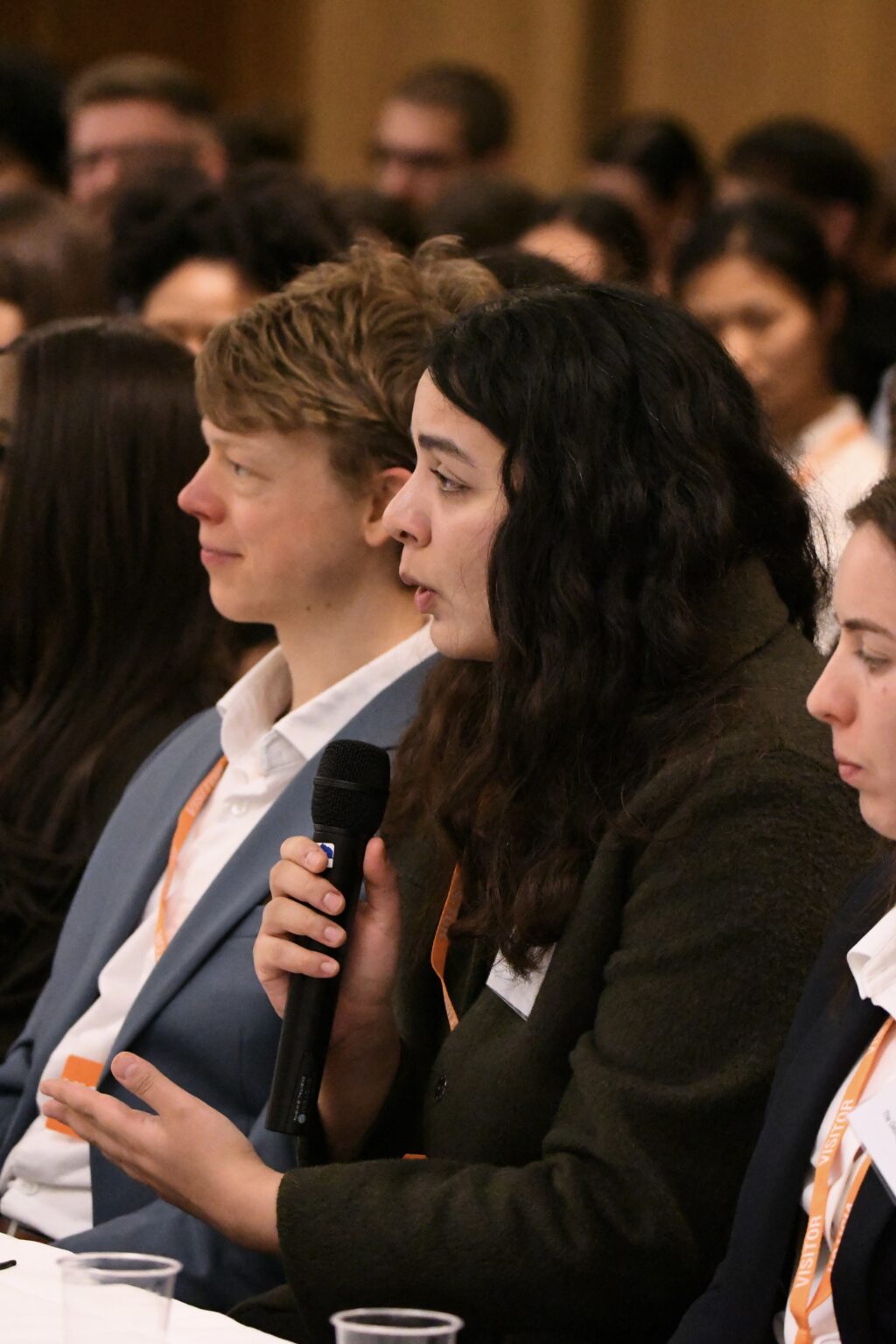
One example question from Esra Sengul to Emily Darlington (MP) and Dr Stephen Michael Wedgwood Benn FRSB (The Viscount Stansgate) in the third session:
“Many researchers across disciplines, particularly early-career researchers, are experiencing increasing precarity due to short-term funding, visa uncertainty, and uneven institutional support. What would you like to see the government do to ensure that upcoming UKRI funding reforms translate into stable career pathways and long-term capacity building across the UK research community?”
The MPs acknowledged the very real difficulties facing researchers at the postdoctoral level, that uncertain, transitional period before a permanent position is secured. However, she was candid about the inherent tension in addressing this: offering longer, more stable contracts comes directly at the cost of the number of contracts available overall. Given an increasingly constrained funding pool, particularly in biomedical science, extending contract lengths necessarily means fewer opportunities exist in total. On international collaboration, Darlington confirmed it remains a clear priority and noted that lessons learned from previous collaborative engagements have actively shaped the direction of current policy thinking.
Perhaps most significantly, Darlington outlined work towards a long-term, stable 10-year plan for research funding. She crucially framed not as a static document but as a continuously updating framework, effectively creating a rolling 10-year horizon. This kind of perpetual forward planning has notably been absent from the UKRI system and was presented as a meaningful structural improvement.
The discussion also touched on the broader science and technology ecosystem, including how government policy is working to support tech and science-driven start-ups, attract talent to the UK, help new companies grow within the British ecosystem, and reduce bureaucratic barriers that can inadvertently stifle innovation.
In the following discussions, Dr Sullivan returned to the contract duration issue raised earlier by Sengul (Genetics Society), reiterating that while short-term contracts are a recognised problem, they are also one mechanism for keeping more talent employed and more opportunities in circulation.
More information about the event can be found here- Voice of the Future 2026 – The Society for Radiological Protection – SRP and Voice of the Future and Voice of the Future Questions 2026 | AMI